
• Home
  • Top Blog
  • Industrial Battery Operated Air Filter for Portable Purity
0%

Table of Contents

In the modern industrial landscape, maintaining air purity in remote or hazardous environments has become a critical priority. The advent of the battery operated air filter offers a revolutionary shift toward portability and independence from fixed power grids, ensuring that clean air is accessible wherever the work is being performed.

Whether deployed in deep mining shafts, temporary construction sites, or specialized metallurgy workshops, these devices provide a vital shield against particulate matter and volatile organic compounds. By integrating high-efficiency filtration media with advanced energy storage, the battery operated air filter empowers technicians to maintain safety standards without the logistical burden of heavy cabling.

Understanding the nuances of these systems—from battery chemistry to filter micron ratings—is essential for any facility manager looking to optimize occupational health. As we move toward more agile manufacturing processes, the adoption of cordless filtration technology represents a significant leap in both operational efficiency and worker protection.

battery operated air filter

Global Relevance of Battery Operated Air Filter

battery operated air filter

Globally, the demand for mobile air purification has surged as industrial sectors face stricter environmental regulations and health mandates. According to ISO standards for indoor air quality, the presence of airborne contaminants in manufacturing zones can lead to a 20% drop in worker productivity and a significant increase in respiratory ailments. The battery operated air filter addresses this by decoupling clean air from the electrical infrastructure.

In emerging economies, where power grids may be unstable or nonexistent in remote mining areas, these portable units are not just a luxury but a necessity. The challenge lies in balancing the weight of the battery with the airflow volume required to effectively scrub the air, a technical hurdle that modern engineering is rapidly overcoming.

Defining the Battery Operated Air Filter System

At its core, a battery operated air filter is an autonomous air purification device that utilizes a rechargeable energy source to power a motorized fan, which pushes contaminated air through a series of filtration media. Unlike stationary HVAC systems, these units are designed for "point-of-use" filtration, meaning they can be placed exactly where the pollutants are generated, such as near a welding station or a mesh weaving loom.

In the context of modern industry, these systems are often integrated with HEPA (High-Efficiency Particulate Air) or activated carbon filters to target specific contaminants. For example, in the specialized equipment manufacturing sector, they are used to remove microscopic metallic dust that could otherwise compromise the precision of delicate machinery or the health of the operator.

Beyond simple filtration, the "battery operated" aspect introduces a layer of flexibility that allows for rapid deployment. This is particularly vital in humanitarian efforts or emergency industrial shutdowns, where air quality must be restored quickly without waiting for electrical installations to be completed.

Core Components for Industrial Performance

The efficacy of a battery operated air filter depends heavily on its energy density. High-capacity Lithium-Iron Phosphate (LiFePO4) batteries are frequently employed because they offer a longer cycle life and greater thermal stability, which is crucial when operating in the high-temperature environments typical of metallurgical plants.

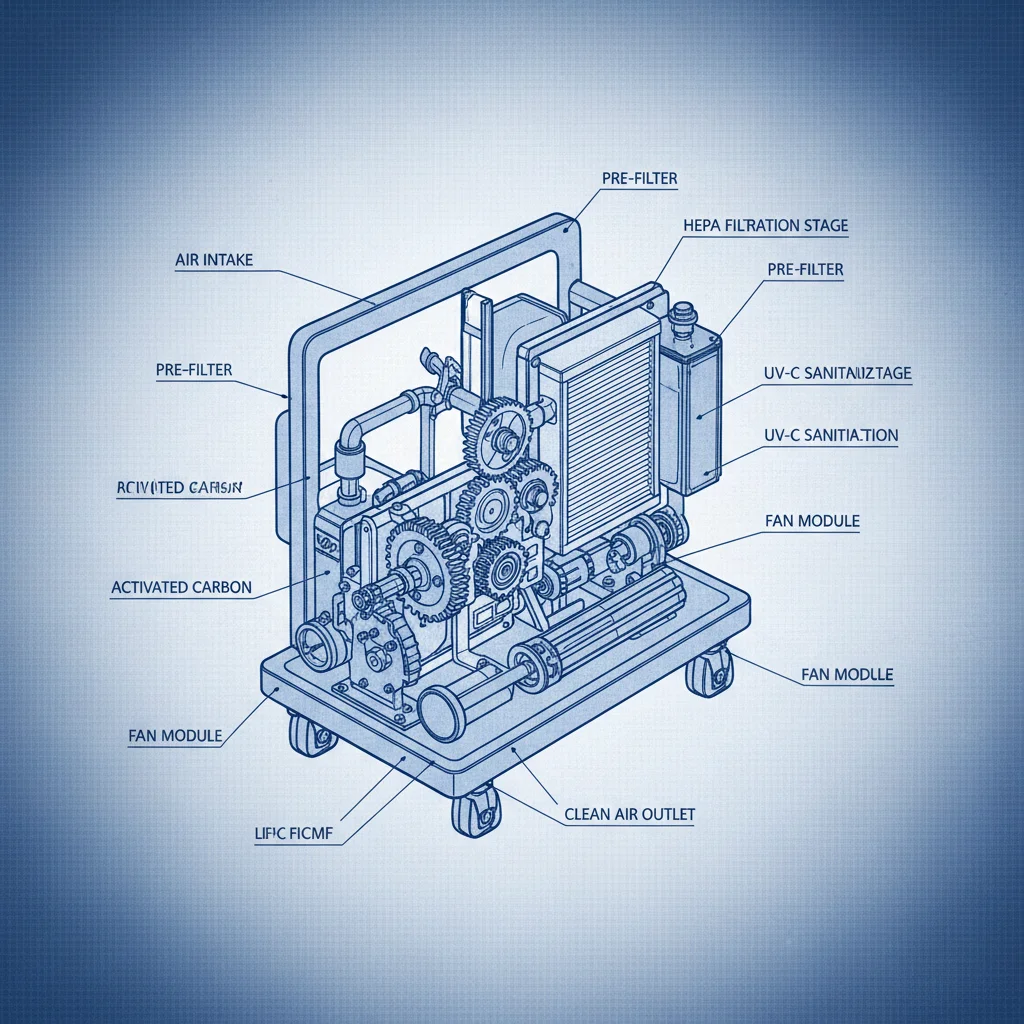
The filtration medium itself is the heart of the system. Industrial-grade battery operated air filter units typically employ a multi-stage approach: a pre-filter to catch large debris, a primary filter for medium particles, and a final HEPA or ULPA stage to capture sub-micron pollutants, ensuring a sterile breathing zone.

Finally, the brushless DC (BLDC) motor provides the necessary suction power while maximizing battery life. These motors are prized for their efficiency and low noise levels, allowing the filtration system to operate continuously in the background of a busy workshop without adding to the acoustic pollution of the factory floor.

Key Performance Factors and Efficiency

When evaluating the performance of these systems, engineers focus on the Clean Air Delivery Rate (CADR) relative to power consumption. A high-performing battery operated air filter must maintain a consistent airflow even as the filter becomes loaded with particulates, requiring an intelligent sensor system that can adjust motor speed automatically.

Furthermore, the scalability of these units allows them to be used in clusters for larger areas or as individual personal protective equipment (PPE) for high-risk tasks. The balance between weight, runtime, and filtration efficiency defines the overall utility of the device in a professional setting.

Comparison of Battery Operated Air Filter Performance Metrics

Real-World Applications in Heavy Industry

In the specialized field of metal wire mesh weaving and welding machine manufacturing, a battery operated air filter is indispensable during the finishing and grinding stages. These processes release fine metallic dust that can linger in the air; portable filters allow workers to create a "clean bubble" around their immediate workspace, reducing the risk of long-term lung damage.

Beyond the factory, these devices are critical in remote industrial zones, such as open-pit mines or offshore platforms, where installing a centralized ventilation system is cost-prohibitive. In these scenarios, the ability to move the filtration unit as the work site shifts ensures that safety is never compromised for the sake of convenience.

Long-Term Value and Sustainability

Investing in a battery operated air filter provides tangible long-term value by reducing healthcare costs and minimizing downtime caused by air quality incidents. From a logical standpoint, the reduction in reliance on permanent electrical installations lowers the overall infrastructure cost of a facility, allowing for a more modular and flexible layout of machinery.

From an emotional and ethical perspective, providing employees with high-quality, portable air filtration demonstrates a commitment to their dignity and well-being. When workers feel safe and protected from invisible hazards, trust in the organization increases, leading to higher retention rates and a more positive corporate culture.

Sustainability is also a key driver; modern units are moving toward biodegradable filter media and recyclable battery components. This shift ensures that while we are cleaning the air in the short term, we are not contributing to landfill waste in the long term, aligning industrial growth with global green energy goals.

Future Innovations in Portable Filtration

The future of the battery operated air filter lies in the integration of IoT (Internet of Things) sensors. Future models will likely feature real-time air quality monitoring that syncs with a central dashboard, alerting supervisors exactly when a filter needs replacing or when a specific zone in the factory has exceeded safety thresholds.

We are also seeing a trend toward "smart energy" management, where AI algorithms optimize the fan speed based on the detected particle concentration. This will significantly extend battery life, allowing units to run for days rather than hours on a single charge, further reducing the operational footprint.

Moreover, advancements in nanomaterials are leading to the development of "electrostatic" battery filters that can capture smaller particles with less air resistance. This means smaller motors, lighter batteries, and even more portable designs that could eventually be integrated directly into worker clothing or wearable gear.

Technical Comparison of Future Battery Operated Air Filter Technologies

Technology Generation Energy Source Filtration Efficiency Connectivity
Standard Battery Lead-Acid/Li-ion Moderate (HEPA) Manual Switch
Smart-Battery LiFePO4 High (HEPA+) Bluetooth/LCD
IoT-Integrated Solid State Very High (ULPA) Cloud Sync/WiFi
Nano-Electrostatic Graphene-Enhanced Ultra High (Nano) AI-Adaptive
Solar-Hybrid Solar + Battery High (Multi-stage) Remote Monitoring
Wearable-Filter Flexible Thin-Film High (Point-of-Use) Biometric Sync

FAQS

How long does a typical battery operated air filter last on a single charge?

Depending on the battery capacity and the fan speed setting, most industrial units provide between 8 to 24 hours of continuous operation. High-end models using LiFePO4 batteries often lean toward the longer end of that spectrum, while compact, wearable versions may require recharging every 4 to 6 hours. Using an "Eco-mode" that adjusts airflow based on real-time air quality can further extend this runtime.

Can these filters remove metallic dust from welding and mesh weaving?

Yes, provided they are equipped with the correct filter media. For metallic dust, a combination of a high-density pre-filter and a HEPA filter is recommended. The pre-filter captures the larger metallic shards, preventing the HEPA filter from clogging too quickly, while the HEPA stage traps the fine particulates that are most hazardous to the lungs.

Is it expensive to maintain a battery operated air filter compared to wired systems?

While the initial purchase price might be higher due to the battery technology, the overall cost of ownership is often lower. You save significantly on electrical installation and wiring costs. Maintenance primarily consists of replacing filter cartridges and occasional battery health checks, which are straightforward tasks that can be performed by on-site staff without specialized electrical training.

Are battery operated air filters safe to use in explosive or high-heat environments?

Safety depends on the certification of the unit. For hazardous environments, you must look for "Intrinsically Safe" or ATEX-certified models. These are specifically designed to prevent electrical sparks from the battery or motor from igniting airborne gases or dust. Always verify the safety ratings of your equipment against the specific hazards of your industrial zone.

How do I know when to replace the filter in a cordless unit?

Many modern units feature a pressure-drop sensor or a timer-based indicator that signals when the filter is saturated. If your unit lacks these, look for a visible change in color of the pre-filter or a noticeable drop in airflow volume. Regularly scheduled maintenance intervals (e.g., every 30 days in high-dust environments) are the best way to ensure consistent performance.

Can these devices be used for large open spaces?

Battery operated air filters are primarily designed for "local" or "spot" filtration. While they are not a replacement for a full-building HVAC system, they are incredibly effective when used in clusters or placed strategically near pollutant sources. For larger areas, we recommend a distributed network of multiple units to maintain a consistent level of air purity.

Conclusion

The implementation of a battery operated air filter represents a critical convergence of energy independence and occupational health. By removing the constraints of fixed power sources, these systems allow for a dynamic approach to air quality management, protecting workers in the most challenging environments of the metallurgy and machinery industries. From the selection of LiFePO4 batteries to the integration of HEPA filtration, every component is designed to ensure that safety is portable, reliable, and efficient.

Looking ahead, the transition toward AI-driven, IoT-enabled filtration will further refine how we manage industrial environments, turning air purification from a reactive task into a proactive strategy. For companies seeking to enhance their operational agility while upholding the highest safety standards, investing in portable filtration technology is not just a regulatory compliance measure—it is a strategic investment in human capital and long-term sustainability. Visit our website for more industrial solutions: www.meshmachinery.com

David Miller

David Miller

David Miller is a seasoned Mechanical Engineer at Hebei Sade Machine Manufacturing Co., Ltd., with over 15 years of experience specializing in wire mesh equipment design and optimization. He joined Sade Machine 8 years ago, initially focusing on the development of our welded wire mesh machines. Currently, David leads a team responsible for enhancing the efficiency and precision of our wire drawing machinery. He holds a Master's degree in Mechanical Engineering from the University of Illinois and is a key contributor to our ISO9001 and CE certification maintenance. David frequently provides technical insights for our industry news, particularly regarding advancements in automated wire processing. He is passionate about driving innovation and ensuring Sade Machine remains at the forefront of the global wire mesh machinery sector.
Previous Industrial Battery Powered Air Filter for Clean Air Mobility
Next Industrial Battery Operated Air Cleaner for Better Air Quality